{{ 'fb_in_app_browser_popup.desc' | translate }} {{ 'fb_in_app_browser_popup.copy_link' | translate }}
{{ 'in_app_browser_popup.desc' | translate }}
🔥9/5 DR.WU會員日,一天限定 點數 2 倍送! 👉<查看更多優惠>
✨換季保養:保濕|控油|防曬 🛒任選3件67折 👉<立即選購>
📣出貨時間調整公告:4/2(四) - 4/7(二)結帳訂單,將一併於 4/8(三)起陸續出貨
{{ childProduct.title_translations | translateModel }}
{{ getChildVariationShorthand(childProduct.child_variation) }}
{{ getSelectedItemDetail(selectedChildProduct, item).childProductName }} x {{ selectedChildProduct.quantity || 1 }}
{{ getSelectedItemDetail(selectedChildProduct, item).childVariationName }}
What is retinol and what does it do?
By Ying-Chin, Wu
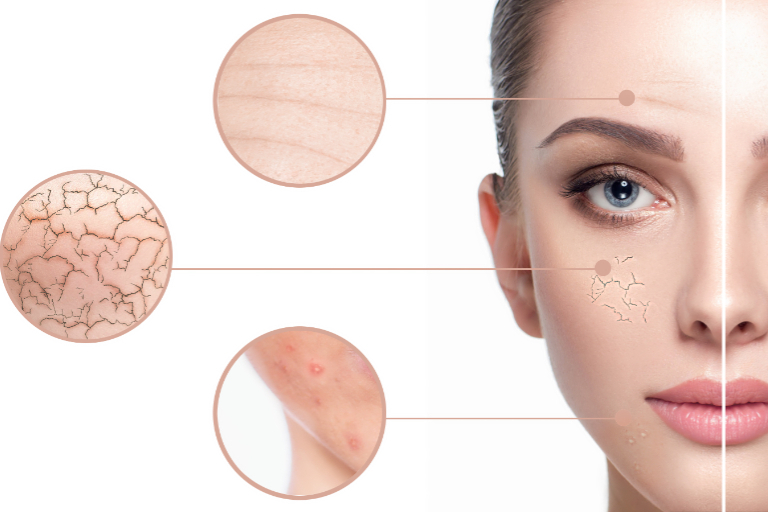
What is retinol? How is it different from retinoic acid? How to use retinol? Recently, there’s been a lot of hype around retinol, attracting hordes of people to get their hands on products with this trending ingredient. While boasting superb skin care efficacy, retinol comes with strong adverse effects, such as experiencing redness, stinging sensations, peeling skin and acne breakouts. Are adverse effects an unavoidable price to pay for retinol’s highly effective skin care results? Don’t want to follow suit and blindly use retinol? Read on and learn all you need to know about retinol, retinoic acid, retinal and retinyl palmitate in 3 minutes.
First off, how is retinol different from retinoic acid?
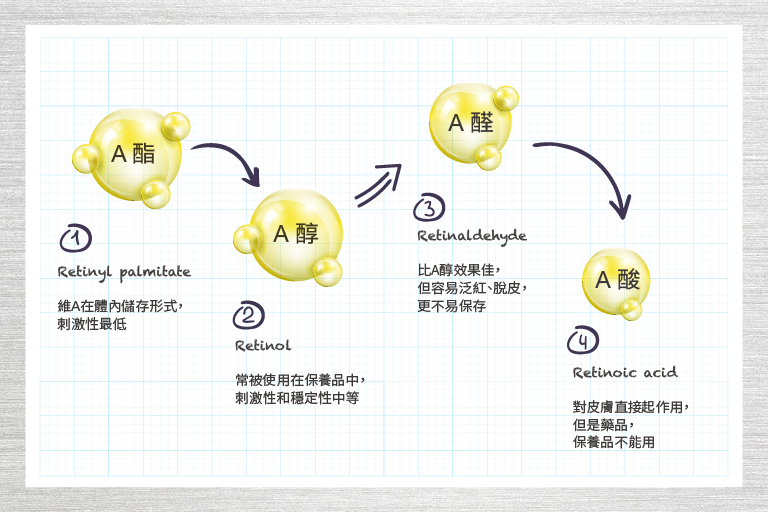
To learn about the efficacy of retinol, you must start with retinoic acid! Retinoic acid is the only ingredient among the vitamin A family (retinoids) that is directly effective after being absorbed by the skin. Since it comes with much stronger irritation, retinoic acid is regulated as a prescription drug for dermatologists. It cannot be added directly to skin care products. Derivatives commonly seen in skin care products such as retinyl palmitate, retinol and retinal are also members of the vitamin A family but in different forms. Eventually, they have to be oxidized and converted into retinoic acid to become effective. What makes them different is the length of the conversion pathway, which affects the levels of efficacy and irritation. Among the three ingredients, it only takes retinal one step to be directly converted into retinoic acid. With the shortest pathway, it is the most effective but most irritating and least stable. The currently popular retinol needs to be converted into retinal before it can be transformed into retinoic acid. It doesn’t deliver results as immediately as retinal, but is less irritating and more stable. Retinyl palmitate is the least irritating and most stable among the three. Yet, due to a 3-step conversion, it takes longer for retinyl palmitate to show results, and it is much milder in comparison.
Retinoic Acid – Your All-Round Skin Care Helper
As early as 1962, retinoic acid was approved for medical use. It was first used to treat cancer, but as it was discovered to be helpful for resisting skin aging, pharmaceuticals collaborated with cosmetic companies to use the income for the continued development of retinoic acid. In 1971, retinoic acid was approved by the US FDA to be used for acne treatment. In 1995, it was proven to be effective in countering photoaging and wrinkles. In 1996, drugs containing retinoic acid for the purpose of reversing signs of aging were released. As the development of retinoic acid matured, cost gradually dropped, and by 2019, retinoic acid had become one of the top 300 commonly used prescription drugs in the US.
In terms of skin treatment, retinoic acid boasts all-round effects. In the epidermis, it can promote the renewal of the skin surface, and assist in the orderly layering of cells in the stratum corneum for a smoother skin texture. In the deep skin layers, it can activate cells such as fibroblasts to increase skin’s elasticity and firmness and to strengthen skin’s structure. It helps the skin become less susceptible to sun damages, and also improves signs of aging such as wrinkles and sagging skin. Retinoic acid also comes with brightening effects. It can inhibit the transfer and synthesis of melanin, so it’s able to brighten skin tone, improve dullness and spots. Retinoic acid is also one of the medicines used for acne treatment in dermatology; thus, there’s no question that it helps control oily skin and fight acne.
The efficacy of retinoic acid shows that it is an all-round skin care ingredient valuable for young to mature skin. Yet, due to its strong irritation, it is categorized as a prescription drug requiring professional review, and cannot be added to skin care products. Another drawback is that the ingredient is highly unstable, and extremely sensitive to light and air. Thus, using it at night and applying sufficient sunscreen in the morning are recommended so that retinoic acid does not lose effectiveness and that the skin, susceptible to photodamage due to retinoic acid, is not harmed by UV rays. Additionally, animal testing suggested that the oral use of retinoic acid during pregnancy may cause serious harm to a fetus. As a result, to avoid the risk, women who are pregnant or nursing should avoid using retinoic acid.
Retinol – The Rising Star of Age Reversal and Skin Revitalization
Retinol is also one form of vitamin A derivatives, and it affects embryonic development in the human body. The use of retinol for skin care has become rather popular in recent years. To deliver skin care effects, retinol needs to be converted into retinoic acid at a ratio of around 6:1 or lower. Although its potency is not as strong as retinoic acid, it can still deliver the same effect. Categorized as an all-round skin care alternative but with milder irritation and better stability than retinoic acid, retinol is no wonder highly sought-after.
In recent years, retinol has become increasingly valued due to its outstanding skin care efficacy. This trend that started overseas has also picked up in Taiwan with searches of retinol tripling in 2022, according to Google Trends. In fact, the development of retinol has been ongoing for almost a century. It was discovered in 1930. In 1937, Swiss chemist Paul Karrer was awarded with the Nobel Prize in Chemistry due to his research in vitamin A. Yet, retinol was not applied to skin care products until the 1980s. In 1997, brands started to launch products featuring retinol.
Retinol skin care has swept the market for the past two years, but major cosmetics companies started preparing for the launch much earlier. In 2002, the number of retinol patents applied by global cosmetics companies peaked, but the ingredient wasn’t incorporated into released products. In 2019, the skin care routine of “Morning C, Night A” gradually grew its popularity and unveiled the trend of retinol skin care. In 2021, some brands started to launch retinol 1% products, and one year later, retinol products can be seen everywhere. While retinol’s efficacy is much desired, its side effects including peeling, redness and stinging have been the topic of discussion in numerous large beauty forums. Seeing many hesitant people interested but intimidated by the side effects, DR.WU set out to launch the next-generation Tri-Retinoid featuring strong potency but with less irritation. Hopefully, more people can enjoy the benefits of retinol skin care.
Retinal–A Highly Promising Rising Star
There is one ingredient among vitamin A derivatives that requires a shorter conversion pathway than retinol – and that is retinal. It only takes retinal one step to be converted into retinoic acid at a ratio of 1:1. It is the most efficient among retinoids in achieving retinoic acid-like skin care efficacy. Since retinal is more irritating than retinol and was previously patented, its use has been more restrained. Yet, as the patent expired a few years ago, more and more brands can use retinal as an ingredient, turning it into a promising rising star.
Retinyl Palmitate – A Gentle Supporting Role in Resisting Aging
As previously mentioned, vitamin A is not a single compound; it comes in many forms. In the animal body, it is mainly stored in the form of retinyl palmitate in the liver. To be converted into retinoic acid, retinyl palmitate requires the most steps, which means its conversion is the longest at a ratio hard to calculate. The advantage is that it hardly causes irritation, and is often used as an antioxidant.
Bonus Read: What not to mix with retinol?
Retinoids can achieve a myriad of skin care effects at once such as resisting aging and firming skin, brightening up skin tone, controlling oily skin and fighting acne, and strengthening the layering of keratinocytes in the stratum corneum, etc. Except for retinyl palmitate, retinoic acid, retinal and retinol are all ingredients that cause the skin more irritations, and yet, dermatologists and formula experts have been obsessed with them. For many years, these professionals have tirelessly delved into research and studies to solve the conundrums of irritation and instability. At-home skin care prioritizes being mild to the skin. Since retinoids tend to cause peeling and stinging, it is not appropriate to use retinoids and skin revitalizing ingredients with a lower pH value such as mandelic acid, BHA and AHA on the same day. Even if you have oily skin with a thicker stratum corneum and want to achieve the ultimate skin revitalizing and firming effects, stagger these ingredients such as using DR.WU Tri-Retinoid Intensive Revitalizing Serum 1.5% on one day and DR.WU Daily Renewal Serum With Mandelic Acid on the next. Similarly, don’t mix vitamin C products with retinoids because vitamin C requires an acidic environment with a lower pH value to be effective, while the optimal pH value for retinol is neutral. When the two are mixed, vitamin A might be less active, while the skin penetration of vitamin C might be weakened. Therefore, following a “Morning C and Night A” routine is recommended.
Related Products: